
The Woods Horse
In the old logging days of GNP, work horses played a major role. In John E. McLeod’s The Northern, he describes the importance of these horses and the work they did. In the beginning of GNP, horses hauled supplies to the log camps in winter on sleds from Greenville to the head of Moosehead Lake (40 miles) on iced-over trails marked by brush stuck in the snow. They all traveled the same marked path, following one another to build up a hard-packed surface. There might have been as many as 20 teams on the ice at once. Four-horse teams also toted supplies to the camps in summer. These teams would haul long, heavy wagonloads of supplies over the tote roads in warm weather…as far as 20 miles.
In 1917-1918, GNP had as many as 1200 horses scattered around at their various farms in the cutting areas. The preferred age of the horses used was about 7-8 years old. After age 10, they were considered unsuitable. A single pair of these horses could move nine tons of pulpwood (four cords) on a well-prepared hauling road.
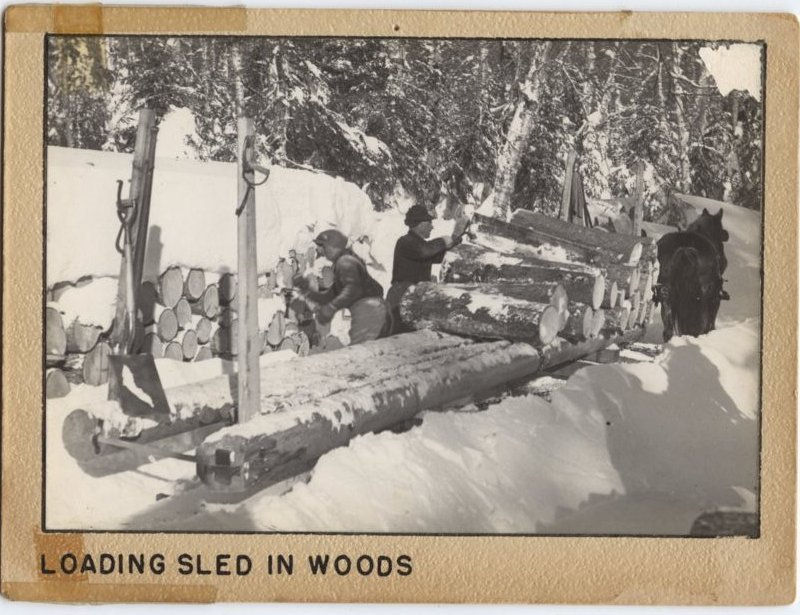
Many of the loaded sleds hauled by these horses were the “double rack” sled which had consisted of two short-connected sleds, each with runners. Stakes were placed at the ends of each of the sleds, allowing for wood to be loaded from the sides. These sleds were pulled by one or two teams of horses. Half-frozen slush was hazardous to the horses so no hauling was done during those conditions.
During the winter hauling months, each horse required as much as 30 lbs. of hay a day and about 17 lbs. of oats. Both crops were grown at the various GNP farms in the cutting areas (Seboomook, Chesuncook and others). In some of the larger locations, the horses were housed in large barns or stables. Often, out in the cutting area, horses stayed in “hovels,” rough dwellings covered with roll roofing (tarred paper).
An interesting note, in the 1920’s, GNP hired the Pinkerton Insurance Agency to chase down horse thieves! Those horses were a valuable company asset! The agents were seen in areas where horses disappeared.
In the long wood days, horses dragged the tree-length wood to the nearest yarding area or branch road, but when it became the 4-foot era, two methods were used…stump cutting and yarding with a 5-man crew and two horses. In the early days, to get to stump wood in difficult places, single horse hauling was done in distances less than a mile. A single horse rack was 18 feet long, could hold up to 2 ½ cords of wood. Two horse teams with a 28 ft. rack would haul about four cords for two miles.
The area where the cutting occurred, the terrain and other things factored into how the wood was moved and horses were used for several years even after trucks came into use.
McLeod describes the woods horse as “a fragile piece of machinery that had to be fed, watered, groomed, shod, rested and sheltered; it was subject to disease and injury, and until just a few years ago, it was indispensable. Great Northern always favored horses, even when oxen were still popular, although as we have noted elsewhere, it bought some of the latter as late as 1910, and some of its contractors used them for some years after that. The Company tried some mules, too, at some unknown early time, but they were not satisfactory.”

Comments