
Millinocket's Housing Development, Part 1
Millinocket’s housing story began with shacks on the mill site for Italian workers and tenement houses and boarding houses near the mill. Over the years, different areas were developed (Little Italy, across the tracks, The Flats, Tin Can Alley, The Pines, etc.) and are still known by the names they were called by early town residents.
McLeod in Story of the Great Northern Paper Company quotes an ad in the Bangor Whig and Currier (July, 1899) asking for responsible parties to erect 100 tenement houses, business blocks, and a suitable hotel and boarding house.
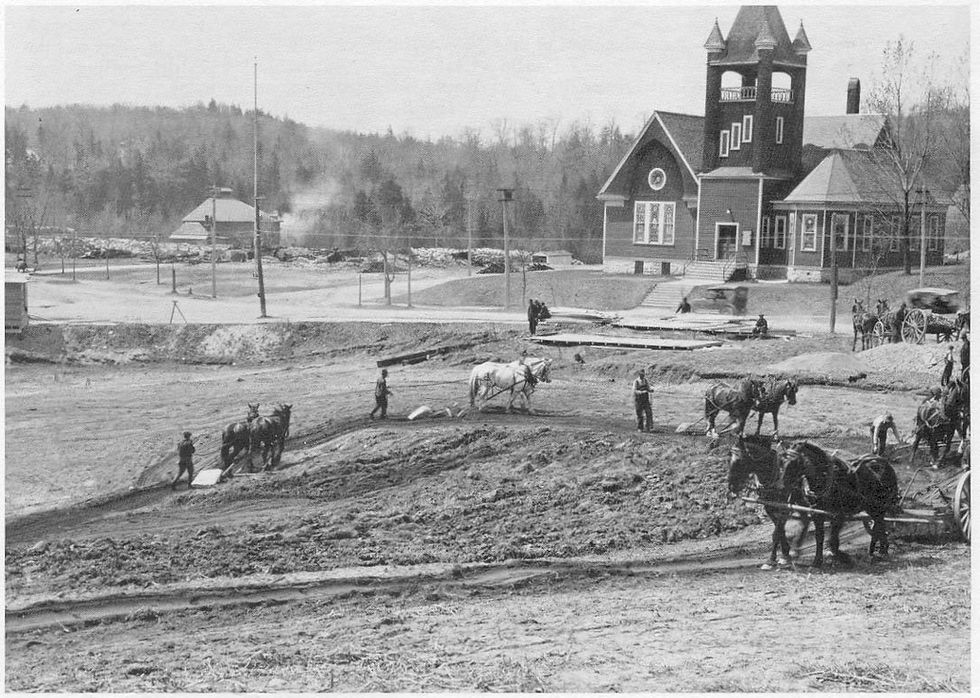
Three to five story boarding houses were erected in the area from the mill along Katahdin Avenue. The Company required each building to have a different appearance and not look like company towns elsewhere. Across from, and near the future park, the boarding houses were more elaborate. (Legassey’s building still has much the same look today with its tower). The Windsor, Little Northern and Exchange (commonly called the Mountain View) were more like hotels than boarding houses. The Great Northern Hotel was constructed a bit farther north and near the center of town. Its Victorian style and ample accommodation attracted people who were here waiting for their homes to be built.
The first housing areas were closest to the mill as all workers walked to work for their eight-hour shifts thus “Across the Tracks” and “Tin Can Alley.” On early maps, Tin Can Alley was technically part of Aroostook Avenue as it still is today. As house lots were in great demand, Schenck, President of GNP, signed quitclaim deeds to hundreds of lots. Each of these deeds contained a clause restricting the sale of liquor on the premises (Laverty’s 2nd book).
There was no plan for an area for GNP executive’s homes. It was not part of the company’s plan for them to live here. The Great Northern Hotel would serve as their quarters when they came from Boston (manufacturing), New York (financial) and Bangor (woodlands) for meetings etc.
Several fine Victorian style homes were erected at the four corners where Highland Avenue crosses Central Street. Two doctors (Cody, Ryan) had their homes there as did George Parks (mill official). Parks left town early, and his home was purchased by Harry Bragdon, undertaker. The fourth home at that intersection was built by William Heebner, a druggist. This home then was owned for years by G.B. Moran, clothing merchant. All four of these homes still retain much the same look as when originally constructed.
In contrast, out near the railroad yard, Frank Rush (sawmill owner) built five small houses for his workers. Three red freight train cabooses were brought near the sawmill for housing purposes. One small, single-story house, formerly a train caboose, was still standing in 1989 when Dorothy Laverty compiled her second book So You Live in Millinocket.


Comments